
The Challenge of Sequential Data Processing
While convolutional neural networks excel at spatial data like images, many important problems involve sequential information where order and context matter fundamentally. Language, audio, stock prices, and sensor readings all exhibit temporal dependencies that standard feedforward networks cannot capture effectively. Recurrent neural networks and their advanced variants provide the architectural innovations needed to process such sequential data.
Sequential data presents unique challenges for machine learning systems. The meaning of a word depends on surrounding words in a sentence. Today's stock price relates to prices from previous days. Understanding a video frame requires context from earlier frames. Standard neural networks treat each input independently, lacking mechanisms to maintain information across sequence positions.
Consider predicting the next word in a sentence. The appropriate prediction depends heavily on preceding words and their relationships. A network that processes words in isolation cannot capture syntax, semantics, or context that makes language meaningful. Sequential processing with memory of previous inputs is essential for tasks involving natural language, time series, and other ordered data.
How Recurrent Neural Networks Work: Memory Through Feedback
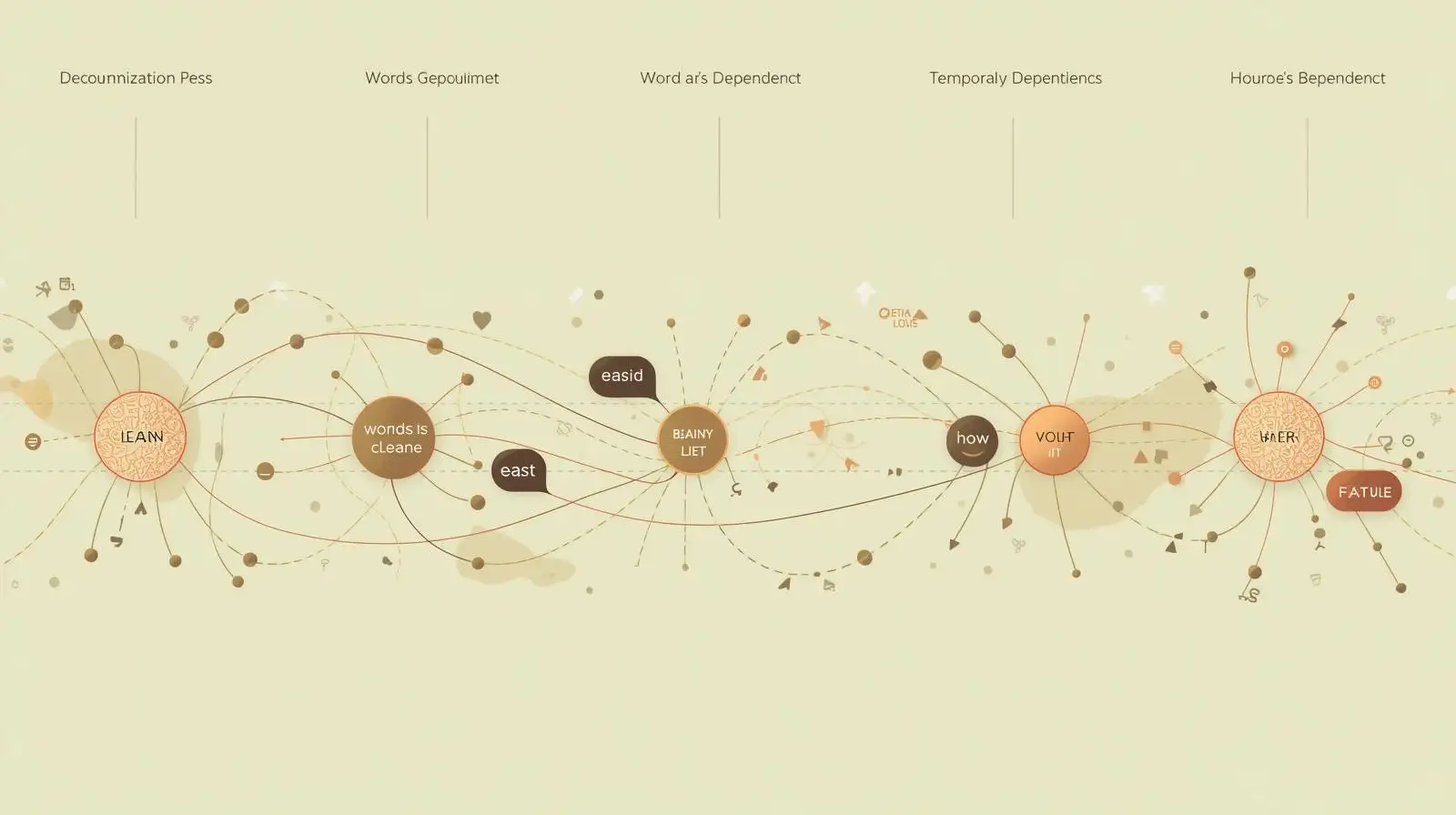
Recurrent neural networks introduce feedback connections that allow information to persist across sequence positions. At each timestep, the RNN receives the current input along with a hidden state encoding information from all previous timesteps. This hidden state acts as memory, enabling the network to consider the entire sequence history when processing each element.
The same network weights apply at every timestep, providing parameter sharing analogous to CNN filter sharing across spatial positions. This weight sharing enables RNNs to process sequences of varying lengths and generalise patterns regardless of their position within sequences. A pattern learned from words appearing early in training sentences can be recognised in later sentence positions.
Training RNNs uses backpropagation through time, which unrolls the network across sequence positions and applies standard backpropagation. Gradients flow backward through time, updating weights based on errors at all positions. This procedure enables learning temporal dependencies but introduces computational challenges as sequence length increases.

The Vanishing Gradient Problem and Its Solutions
Standard RNNs struggle with long sequences due to the vanishing gradient problem. As gradients propagate backward through many timesteps, they shrink exponentially due to repeated multiplication through activation function derivatives. Gradients become negligibly small, preventing the network from learning dependencies spanning many positions. Information from early sequence elements effectively disappears before influencing later processing.
The exploding gradient problem presents the opposite challenge where gradients grow uncontrollably large, causing unstable training. Gradient clipping addresses this issue by scaling gradients that exceed a threshold. However, vanishing gradients require more fundamental architectural changes to enable long-range dependency learning.
This limitation motivated development of gated architectures that control information flow more precisely. Rather than allowing gradients to decay through simple multiplication, gated networks learn when to remember, forget, and output information—providing highways for gradients to flow across many timesteps without vanishing.
Long Short-Term Memory Networks: Gated Memory Cells
Long Short-Term Memory networks overcome vanishing gradients through sophisticated gating mechanisms that control information flow. Each LSTM cell maintains a cell state that can carry information across many timesteps with minimal transformation. Gates determine what information to add, remove, or output from this cell state at each position.
The forget gate decides what information to discard from the cell state based on the current input and previous hidden state. Values near one preserve cell state contents while values near zero erase them. This mechanism allows the network to maintain relevant information indefinitely while discarding outdated or irrelevant content.
The input gate controls what new information enters the cell state. A candidate update vector contains potential new values, and the input gate determines which elements actually update the cell state. The output gate then selects which cell state components contribute to the current hidden state output, allowing selective exposure of internal memory to subsequent processing.
LSTM's gating mechanism was revolutionary—it enabled learning dependencies across hundreds of timesteps where standard RNNs failed. This made practical applications like machine translation and speech recognition possible.
Explore NLP Applications →
Gated Recurrent Units: Simplified Architecture
Gated Recurrent Units provide a simplified alternative to LSTM with comparable performance on many tasks. GRUs combine the forget and input gates into a single update gate, reducing the number of parameters and computations required. A reset gate determines how much previous hidden state to consider when computing candidate updates.
The simpler GRU architecture trains faster and requires less memory than LSTM while achieving similar results on sequence modelling tasks. Neither architecture consistently outperforms the other across all problems, making the choice often a practical consideration of computational constraints and empirical performance on specific datasets.
Both LSTM and GRU remain practical choices for many applications, particularly those involving streaming data or resource-constrained environments. While transformer architectures have recently achieved impressive results on some sequence tasks, recurrent architectures offer advantages in scenarios requiring online processing or limited memory.
Practical Applications of RNNs and LSTMs
Natural language processing represents the most prominent application domain for recurrent architectures. Sentiment analysis classifies text as positive, negative, or neutral by processing word sequences and producing a final classification. Machine translation transforms sentences from one language to another using encoder-decoder architectures where one RNN encodes the source sentence and another generates the target translation.
Time series forecasting uses LSTM networks to predict future values based on historical observations. Financial applications predict stock prices, trading volumes, and market volatility. Energy systems forecast electricity demand for grid management. Weather prediction models process atmospheric sensor readings to produce forecasts across varying time horizons.
Speech recognition converts audio waveforms into text by processing acoustic features through recurrent layers. Voice assistants rely on RNN-based speech recognition to understand user commands. Music generation systems create novel compositions by learning patterns from existing musical sequences and predicting subsequent notes or chords.
Frequently Asked Questions
What is a recurrent neural network?
An RNN is a neural network architecture with feedback connections that maintain information across sequence positions. Unlike feedforward networks that process inputs independently, RNNs maintain hidden state that encodes previous inputs, making them ideal for sequential data like text, audio, and time series.
What is the vanishing gradient problem?
As gradients propagate backward through many timesteps during training, they shrink exponentially due to repeated multiplication through activation functions. This prevents standard RNNs from learning long-range dependencies—information from early sequence elements effectively vanishes before influencing later processing.
How do LSTM networks solve the vanishing gradient problem?
LSTMs use gating mechanisms—forget, input, and output gates—that control information flow through a dedicated cell state. This architecture allows information to persist across many timesteps with minimal transformation, enabling gradient flow and learning of long-range dependencies that standard RNNs cannot capture.
What is the difference between LSTM and GRU?
GRUs simplify LSTM architecture by combining forget and input gates into a single update gate, using fewer parameters. GRUs often train faster and require less memory while achieving similar performance. Neither consistently outperforms the other—the choice typically depends on computational constraints and empirical results on your specific task.
What applications use RNNs and LSTMs?
Applications include natural language processing (sentiment analysis, machine translation), speech recognition and synthesis, time series forecasting (financial markets, energy demand, weather), music generation, video captioning, and any task involving sequential patterns or temporal dependencies.
Explore Modern NLP and Generative AI
Discover how these foundations led to transformers, large language models, and generative AI applications.
📚 Related Reading
💬 Questions or Thoughts?
Create a free account to join the conversation.