
Foundations of Natural Language Processing
Natural language processing enables machines to understand, interpret, and generate human language, bridging the gap between human communication and computer systems. From chatbots and virtual assistants to content generation and sentiment analysis, NLP applications have become embedded in daily technology interactions. As AI capabilities advance, natural language processing continues expanding into increasingly sophisticated applications that transform how we work and communicate.
Natural language processing combines linguistics, computer science, and machine learning to analyse and generate text. Human language presents unique challenges for computational systems due to ambiguity, context dependence, and the vast vocabulary and grammatical structures involved. Effective NLP requires breaking down these complexities into manageable computational problems.
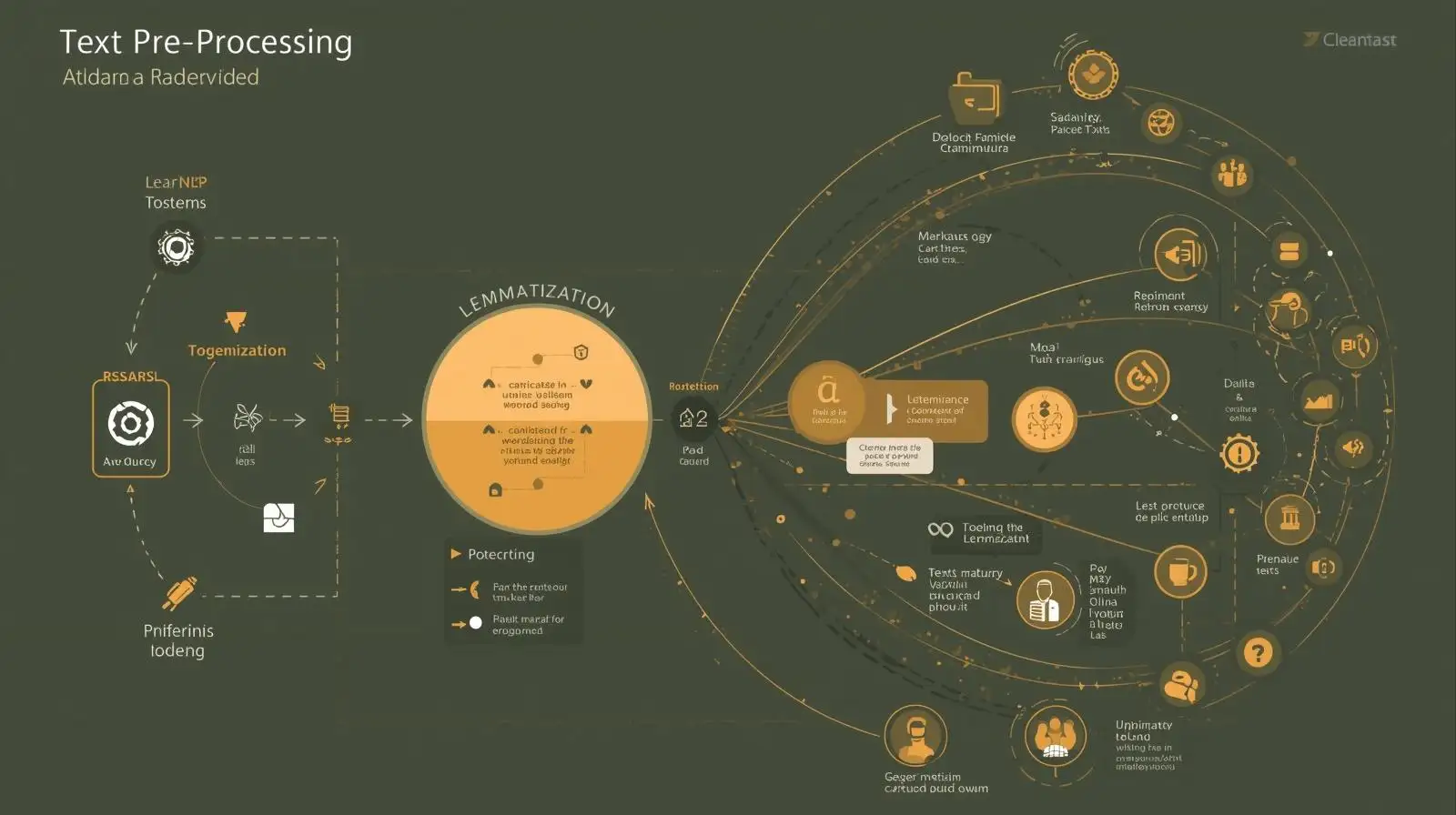
Text preprocessing transforms raw text into formats suitable for analysis. Tokenisation divides text into individual words, sentences, or subword units that serve as model inputs. Lowercasing removes case distinctions that might confuse analysis. Stop word removal eliminates common words like articles and prepositions that add little semantic value. Lemmatisation reduces words to base forms, grouping variations together.
Text Representation: From Bag of Words to Word Embeddings
Representing text numerically enables applying machine learning algorithms to language tasks. The bag of words model creates vectors counting word occurrences within documents, ignoring word order entirely. This simple representation works surprisingly well for document classification despite losing sequential information. Term frequency-inverse document frequency weighting improves bag of words by downweighting common words and emphasising distinctive terms.
Word embeddings revolutionised NLP by representing words as dense vectors in continuous space where semantic relationships correspond to geometric relationships. Words with similar meanings cluster together while analogical relationships emerge as vector arithmetic operations. Adding the difference between "king" and "man" to "woman" produces a vector near "queen," demonstrating how embeddings capture meaningful linguistic patterns.
Pre-trained embedding models like Word2Vec and GloVe learn vector representations from massive text corpora, capturing general semantic knowledge transferable to specific tasks. Using pre-trained embeddings accelerates development and improves performance, especially when task-specific training data is limited. Fine-tuning embeddings on domain-specific text can further improve performance for specialised applications.

Modern NLP with Transformers and Large Language Models
Transformer architectures have redefined natural language processing capabilities, enabling unprecedented performance on understanding and generation tasks. Unlike recurrent networks that process sequences position by position, transformers use attention mechanisms to relate all positions simultaneously. This parallel processing dramatically accelerates training while attention enables modelling long-range dependencies more effectively than LSTM networks.
Large language models like GPT and BERT build on transformer architectures, training on vast text collections to develop broad language understanding. BERT uses masked language modelling where the model predicts hidden words based on surrounding context, learning bidirectional representations. GPT models train to predict the next word in sequences, developing generation capabilities alongside comprehension.
These models demonstrate remarkable few-shot and zero-shot learning abilities, performing tasks they were never explicitly trained for simply by processing appropriate prompts. The emergence of such capabilities from scale alone has surprised researchers and enabled new application paradigms. Users can direct model behaviour through natural language instructions rather than task-specific training.
Transformers enabled a paradigm shift: instead of building specialised models for each task, we can now use general-purpose models that understand instructions. This democratises AI applications and accelerates development.
Explore AI Tools →Generative AI Applications: Creating Content with Artificial Intelligence
Generative AI extends beyond understanding to creating new content across modalities including text, code, images, and audio. Language models generate coherent articles, stories, and technical documentation. Code generation systems write functional programs from natural language descriptions. Multimodal models create images from text prompts or describe visual content in natural language.
Marketing teams leverage AI content generators to produce advertising copy, social media posts, and email campaigns at scale. The technology handles routine content creation while human creativity focuses on strategy and review. Blog posts, product descriptions, and promotional materials that once required hours of writing can be drafted in minutes with AI assistance.
Code assistant applications help developers write, explain, and debug software. These tools understand programming languages alongside natural language, translating requirements into functional code and explaining complex implementations in accessible terms. Documentation generation automatically produces descriptions for code modules, improving maintainability and knowledge sharing within development teams.

Building AI-Powered Applications
Conversational AI chatbots provide personalised assistance across domains from customer service to financial planning. Building effective chatbots requires combining language understanding with domain knowledge and appropriate response generation. Modern approaches use large language models with retrieval augmentation to ground responses in relevant information sources while maintaining conversational flow.
Intelligent document processing extracts structured information from unstructured text documents. Invoice processing systems identify vendors, amounts, and line items from varied document formats. Legal document analysis tools highlight relevant clauses and flag potential issues. Resume parsing extracts candidate qualifications for recruitment systems. These applications combine OCR, named entity recognition, and classification to automate previously manual processes.
Agricultural technology demonstrates AI's potential for social impact through applications like pest monitoring systems. Farmers photograph crops and receive AI-powered analysis identifying pest infestations with recommendations for intervention. Image recognition models trained on pest and disease datasets provide expertise previously requiring scarce agricultural specialists. Such applications democratise knowledge access while protecting food production.
The Future of Artificial Intelligence: Trends and Opportunities
Artificial intelligence development accelerates across multiple frontiers simultaneously. Multimodal AI systems seamlessly combine text, image, audio, and video understanding within unified models. Agentic AI architectures enable autonomous systems that plan, execute, and adapt complex multi-step tasks. Smaller, more efficient models bring AI capabilities to edge devices and resource-constrained environments.
Responsible AI development gains increasing attention as capabilities expand. Researchers work to understand and mitigate biases encoded in training data and model behaviour. Explainability techniques illuminate how models reach conclusions, supporting appropriate trust calibration. Governance frameworks balance innovation incentives with safety considerations and societal impact.
Opportunities abound for practitioners who combine technical AI skills with domain expertise. Healthcare, education, sustainability, and countless other fields await AI solutions tailored to their specific challenges. The technology has matured to the point where implementation often matters more than algorithmic novelty. Building practical applications that deliver real value represents the frontier for applied AI practitioners.
The journey from understanding basic AI concepts to building sophisticated applications has never been more accessible. Frameworks, pre-trained models, cloud infrastructure, and educational resources lower barriers that once limited AI development to specialised research labs. Whether starting from zero or advancing existing skills, the path to AI proficiency offers tremendous potential for personal and professional growth.
AI represents not just a technology but a fundamental shift in human capability. Engaging with AI development today positions you to shape and benefit from this transformation.
Find Your Path →
Frequently Asked Questions
What is natural language processing?
NLP combines linguistics, computer science, and machine learning to enable computers to understand, interpret, and generate human language. It powers applications like chatbots, translation services, sentiment analysis, voice assistants, and content generation systems that have become integral to modern technology.
What are large language models?
LLMs are transformer-based neural networks trained on vast text collections—billions of words from books, websites, and documents. Models like GPT and BERT develop broad language understanding through sheer scale, enabling tasks like text generation, translation, summarisation, and question answering without requiring task-specific training.
What is generative AI?
Generative AI creates new content across modalities including text, code, images, audio, and video. Unlike analytical AI that classifies or predicts from existing data, generative models produce original outputs—articles, programs, artwork, music—by learning patterns from training data and applying them creatively.
How do word embeddings work?
Word embeddings represent words as dense numerical vectors in continuous space where semantic relationships correspond to geometric relationships. Similar words cluster together (cat, dog, pet), and analogical relationships emerge through vector arithmetic. This representation enables machines to understand meaning and relationships between words.
What is the future of AI?
AI development accelerates across multimodal systems that understand text, images, and audio together; agentic architectures that autonomously complete complex tasks; and efficient models running on edge devices. Responsible development focuses on fairness, transparency, and alignment with human values. Opportunities abound for practitioners combining AI skills with domain expertise.
Start Your AI Journey Today
You've completed the AI fundamentals series. Now explore practical applications, discover tools, and find opportunities to apply what you've learned.
📚 Complete AI Learning Path
💬 Questions or Thoughts?
Create a free account to join the conversation.