
What is Machine Learning? Core Concepts and Principles
Machine learning represents the engine powering modern artificial intelligence, enabling computers to learn from data without explicit programming. From predicting customer behaviour to detecting fraudulent transactions, machine learning algorithms have become indispensable tools across industries. Understanding how these algorithms work unlocks the ability to apply them effectively to real-world problems.
Machine learning is a subset of artificial intelligence focused on developing systems that improve through experience. Rather than programming explicit rules for every situation, developers train machine learning models on datasets that contain examples of desired behaviour. The algorithms identify patterns within this training data and apply learned patterns to make predictions on new, unseen information.
Consider email classification as an illustrative example. Traditional programming would require defining rules for spam detection: if an email contains certain words, mark it as spam. This approach fails when spammers change their tactics. Machine learning takes a different approach by analysing thousands of labelled emails, learning characteristics that distinguish legitimate messages from spam, and continuously improving as it encounters new examples.
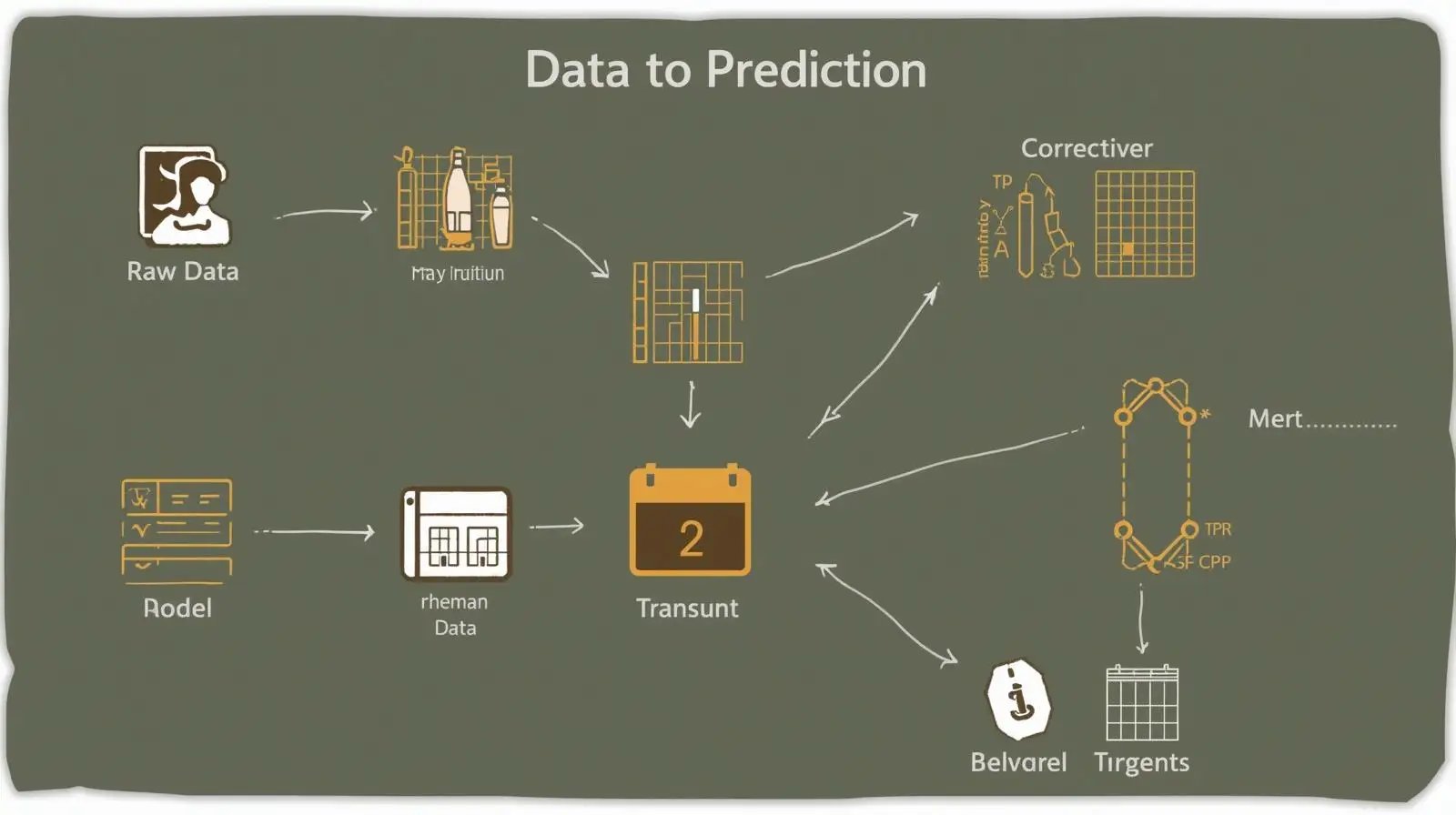
Supervised Learning: Training with Labelled Data
Supervised learning algorithms learn from labelled datasets where both input features and corresponding correct outputs are provided. The algorithm attempts to learn a mapping function that predicts the output given new inputs. This category includes regression problems, where outputs are continuous values, and classification problems, where outputs belong to discrete categories.
Linear regression serves as the foundational supervised learning algorithm for predicting continuous outcomes. Given historical data about house prices and their features like square footage, location, and number of bedrooms, linear regression learns relationships between these variables. The trained model can then estimate prices for new properties based on their characteristics.
Logistic regression, despite its name, handles classification tasks rather than regression. This algorithm predicts probabilities of categorical outcomes, making it ideal for binary decisions like spam detection, disease diagnosis, or customer churn prediction. The algorithm produces probability values between zero and one, which threshold rules convert into final classifications.
Decision Trees and Random Forests
Decision tree algorithms create flowchart-like structures that make predictions through a series of questions about input features. Each internal node represents a test on an attribute, branches represent test outcomes, and leaf nodes contain final predictions. This structure makes decision trees highly interpretable, allowing humans to trace exactly how the model reached any particular conclusion.
Random forests address decision tree limitations by combining multiple trees trained on different data subsets. Each tree votes on the final prediction, and the forest aggregates these votes to produce more robust, accurate results. This ensemble approach reduces overfitting and generally outperforms single decision trees on complex problems.

Unsupervised Learning: Discovering Hidden Patterns
Unsupervised learning algorithms work with unlabelled data, seeking to discover inherent structures and patterns without guidance about correct answers. These techniques prove invaluable when labelled data is scarce, expensive to obtain, or simply unavailable. Common applications include customer segmentation, anomaly detection, and dimensionality reduction.
Clustering algorithms group similar data points together based on their characteristics. K-means clustering, one of the most popular approaches, partitions data into a specified number of clusters by minimising within-cluster variance. Marketing teams use clustering to segment customers based on purchasing behaviour, enabling targeted campaigns tailored to each group's preferences.
The power of unsupervised learning lies in its ability to reveal structure you didn't know existed. When you don't have labels telling you the answer, the algorithm finds natural groupings and patterns in your data. This can lead to insights that wouldn't emerge from supervised approaches, where you're constrained by predefined categories.
Understanding these algorithms helps you identify which approach fits your problem. Have labelled historical data? Supervised learning. Need to find patterns in unlabelled data? Unsupervised learning. Many real-world solutions combine both.
Explore ML Tools →Probabilistic Learning: Bayes Theorem and Naive Bayes
Probability theory provides a mathematical foundation for machine learning under uncertainty. Bayes theorem describes how to update probability estimates as new evidence becomes available, forming the basis for powerful classification and prediction algorithms. Understanding conditional probability enables building systems that reason effectively about uncertain situations.
Naive Bayes classifiers apply Bayes theorem with a simplifying assumption that input features are conditionally independent given the class label. Despite this seemingly unrealistic assumption, Naive Bayes performs remarkably well on many real-world problems, particularly text classification tasks. The algorithm's computational efficiency and ability to handle high-dimensional data make it a practical choice for large-scale applications.
Consider weather prediction for outdoor activities. Given historical data about weather conditions and whether games were played, Naive Bayes calculates the probability of playing based on current conditions. By computing probabilities for each feature independently and combining them according to Bayes theorem, the algorithm produces reliable predictions even with limited training data.

Recommendation Systems: Personalisation at Scale
Recommendation systems represent one of machine learning's most visible applications, powering personalised experiences on platforms like Netflix, Amazon, and Spotify. These systems analyse user behaviour patterns to suggest content, products, or connections likely to interest individual users. Two primary approaches dominate the field: collaborative filtering and content-based filtering.
Collaborative filtering makes recommendations based on similarities between users or items. If users with similar viewing histories enjoyed a particular movie, the system recommends that movie to others in the group. Matrix factorisation techniques decompose large user-item matrices into smaller factors that capture latent preferences, enabling predictions for user-item combinations never explicitly rated.
Content-based filtering analyses item characteristics to recommend similar items to those a user previously liked. If someone enjoys science fiction movies, the system recommends other films in that genre. Modern recommendation systems often combine both approaches in hybrid architectures that leverage complementary strengths of each method.
Evaluating Machine Learning Models: Metrics and Best Practices
Proper evaluation ensures machine learning models generalise beyond training data to perform well on new examples. Splitting data into training, validation, and test sets prevents overfitting and provides honest performance estimates. Cross-validation techniques further improve reliability by training and evaluating on multiple data partitions.
Different metrics suit different problem types. Classification tasks often use accuracy, precision, recall, and F1 score, each capturing different aspects of performance. Regression problems typically evaluate using mean squared error, mean absolute error, or R-squared values. Selecting appropriate metrics aligned with business objectives ensures optimisation efforts improve outcomes that actually matter.
Understanding machine learning algorithms provides the foundation for applying artificial intelligence to practical problems. Each algorithm offers distinct advantages suited to particular data types and business requirements. Mastering these techniques positions practitioners to select appropriate approaches, tune hyperparameters effectively, and build systems that deliver genuine value.
Ready to go deeper? Our guide on deep learning and neural networks builds on these foundations to explore more advanced AI architectures.
Learn Deep Learning →Frequently Asked Questions
What is the difference between supervised and unsupervised learning?
Supervised learning uses labelled data where both inputs and correct outputs are provided, allowing algorithms to learn the mapping between them. Unsupervised learning works with unlabelled data, discovering hidden patterns and structures without guidance about correct answers. Choose supervised when you have labelled examples; unsupervised when you want to discover natural patterns.
What are the most common machine learning algorithms?
Common supervised algorithms include linear regression for continuous predictions, logistic regression for classification, decision trees for interpretable models, random forests for robust predictions, and support vector machines for complex boundaries. Popular unsupervised algorithms include k-means clustering for grouping and principal component analysis for dimensionality reduction.
How do recommendation systems work?
Recommendation systems use collaborative filtering (finding similar users or items based on behaviour patterns) and content-based filtering (analysing item characteristics to find similar items) to suggest relevant content. Modern systems often combine both approaches in hybrid architectures, leveraging user behaviour data and item metadata for more accurate personalised recommendations.
What is the role of probability in machine learning?
Probability theory provides the mathematical foundation for machine learning under uncertainty. Bayes theorem describes how to update probability estimates as new evidence becomes available, forming the basis for algorithms like Naive Bayes classifiers. Probabilistic approaches help systems reason about confidence levels and handle noisy or incomplete data.
How do you evaluate machine learning model performance?
Model evaluation uses metrics appropriate to the problem type. Classification tasks typically use accuracy, precision, recall, and F1 score to measure different aspects of prediction quality. Regression problems use mean squared error, mean absolute error, or R-squared values. Cross-validation on held-out data ensures models generalise beyond training examples.
Ready for Deep Learning?
Now that you understand machine learning foundations, explore how neural networks take these concepts further with deep learning architectures.
📚 Related Reading
💬 Questions or Thoughts?
Which machine learning concepts would you like explained further? Share below.
Join the conversation! Create a free account to leave comments and connect with other learners.