What are Neural Networks? Architecture and Components
Deep learning has revolutionised artificial intelligence by enabling machines to learn hierarchical representations of data, achieving breakthrough performance on tasks previously considered impossible for computers. From recognising speech to generating realistic images, deep neural networks power the most impressive AI capabilities available today.
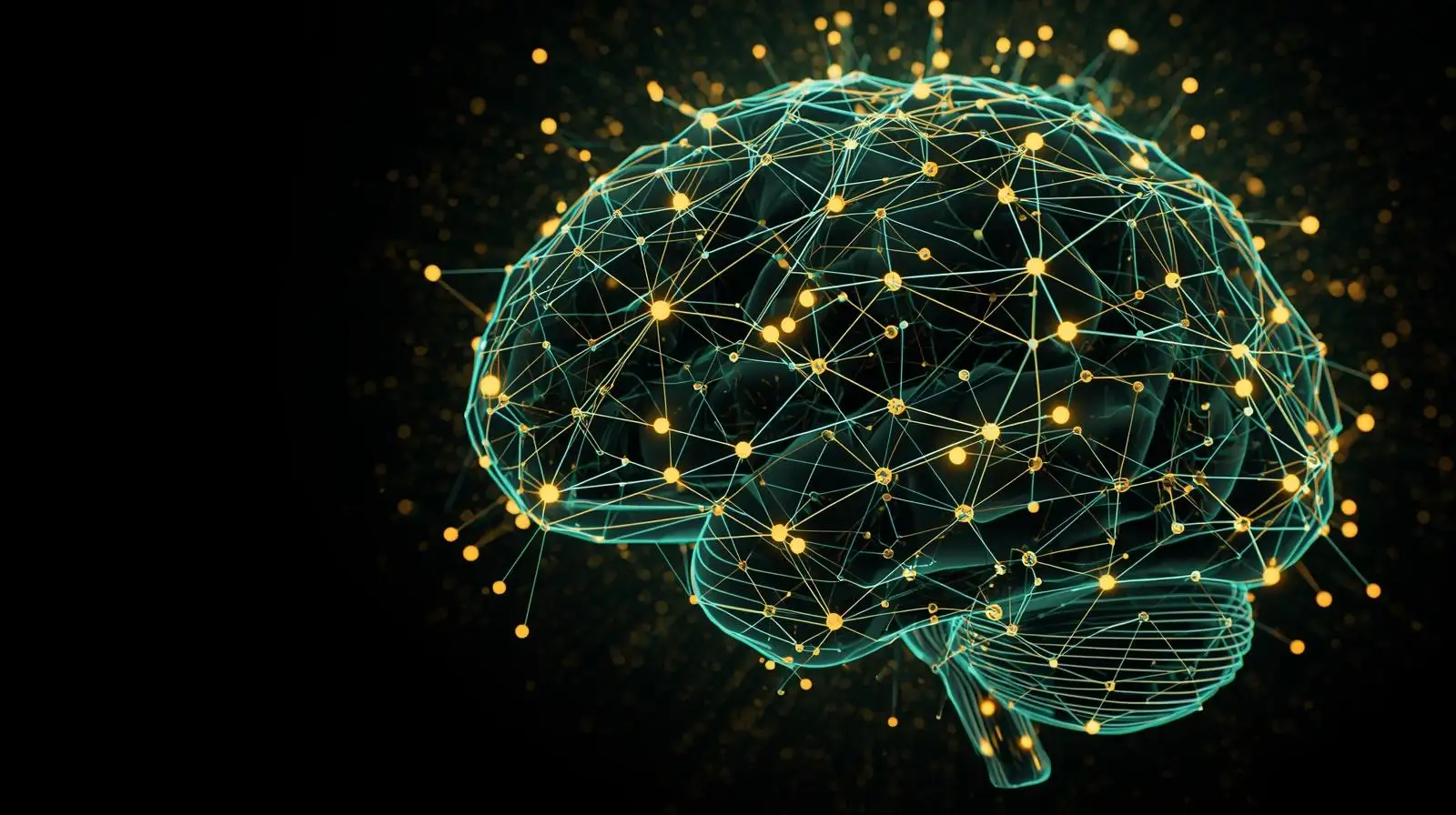
Artificial neural networks draw inspiration from biological brains, organising computational units called neurons into interconnected layers. Each neuron receives inputs, applies weights to those inputs, sums the weighted values, and passes the result through an activation function that determines the neuron's output. This simple structure, replicated across thousands or millions of neurons, creates systems capable of learning remarkably complex patterns.
A basic neural network consists of an input layer that receives raw data, one or more hidden layers that transform the data through learned representations, and an output layer that produces final predictions. Connections between layers carry weights that the network adjusts during training. The depth and width of hidden layers significantly impact the network's capacity to model complex relationships.

How Neural Networks Learn: Forward and Backward Propagation
Neural network training involves two complementary processes that work together to optimise network weights. Forward propagation passes input data through the network, computing activations at each layer until reaching the output. The network compares its predictions against correct answers using a loss function that quantifies prediction error.
Backpropagation then propagates this error backward through the network, calculating how much each weight contributed to the total loss. Using calculus-based gradient descent, the algorithm adjusts weights in directions that reduce error. Repeated iterations of this forward-backward cycle gradually tune millions of parameters to minimise prediction errors on training data.
The learning rate hyperparameter controls how aggressively the network updates weights based on computed gradients. Too large a learning rate causes unstable training with weights oscillating wildly. Too small a learning rate makes training painfully slow and risks getting stuck in suboptimal solutions. Finding appropriate learning rates requires experimentation and often employs adaptive techniques that adjust rates automatically during training.
Deep Learning Frameworks: TensorFlow, PyTorch, and Beyond
Modern deep learning development relies on sophisticated frameworks that handle low-level implementation details while providing high-level APIs for model construction and training. TensorFlow, developed by Google, offers production-ready tools for deploying models at scale across diverse platforms. Its computational graph approach represents operations as nodes in a directed graph, enabling efficient execution and automatic differentiation.
PyTorch, created by Facebook's AI research team, emphasises dynamic computational graphs that change during runtime. This flexibility simplifies debugging and experimentation, making PyTorch particularly popular in research settings. The framework's Pythonic design integrates seamlessly with the broader Python data science ecosystem, facilitating rapid prototyping and iterative development.
Keras provides a high-level neural network API that runs on top of TensorFlow or other backends. Its intuitive interface allows building complex models by simply stacking layers, dramatically lowering the barrier to entry for deep learning practitioners. Keras strikes an excellent balance between ease of use and flexibility, making it ideal for beginners while remaining powerful enough for production applications.
These frameworks make deep learning accessible without PhD-level mathematics. Start with Keras for its simplicity, then explore PyTorch or TensorFlow as your needs grow.
Explore AI Tools →Activation Functions: Adding Non-linearity to Networks
Activation functions introduce non-linearity into neural networks, enabling them to learn complex, non-linear relationships in data. Without activation functions, even deep networks with many layers would only learn linear transformations, severely limiting their modelling capacity. Different activation functions offer different properties suited to various network architectures and tasks.
The rectified linear unit, commonly called ReLU, outputs zero for negative inputs and passes positive values unchanged. This simple function has become the default choice for hidden layers due to its computational efficiency and ability to mitigate vanishing gradient problems that plagued earlier sigmoid-based networks. Variants like Leaky ReLU and ELU address ReLU's limitation of completely blocking negative gradients.
Softmax activation transforms network outputs into probability distributions, making it ideal for multi-class classification output layers. The function ensures outputs sum to one while amplifying differences between values, providing interpretable class probabilities. Sigmoid activation similarly produces values between zero and one, commonly used for binary classification or multi-label problems.
Preventing Overfitting: Regularisation Techniques
Deep neural networks with millions of parameters risk memorising training data rather than learning generalisable patterns. Overfitting manifests as excellent training performance but poor results on new data. Various regularisation techniques combat overfitting by constraining network capacity or adding noise during training.
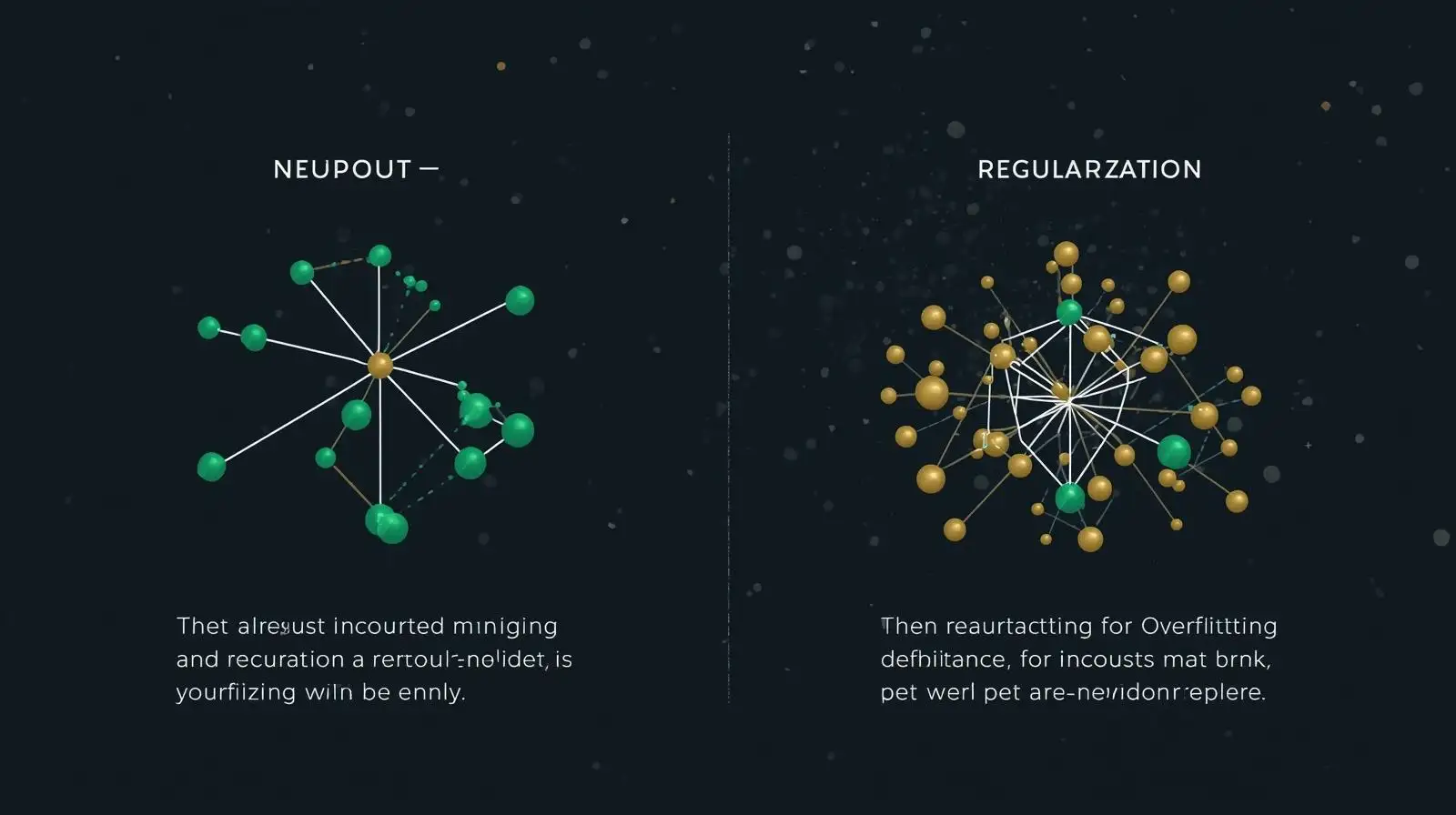
Dropout randomly deactivates a fraction of neurons during each training iteration, forcing the network to learn redundant representations. This technique effectively trains an ensemble of different network architectures that share weights, improving generalisation. At inference time, all neurons remain active but outputs scale to account for the difference in active connections.
L1 and L2 regularisation add penalty terms to the loss function based on weight magnitudes. L2 regularisation encourages smaller weights overall, while L1 regularisation drives some weights to exactly zero, effectively performing feature selection. Early stopping monitors validation performance during training and halts when improvement stalls, preventing the network from continuing to fit training noise.
Practical Deep Learning Applications
Deep learning continues advancing rapidly, with new architectures and techniques emerging regularly. Mastering foundational concepts positions practitioners to understand and adopt innovations as they appear. The combination of theoretical understanding and hands-on practice builds expertise applicable across the expanding range of deep learning applications.
From image classification and object detection to natural language processing and generative AI, deep learning powers the most impressive AI capabilities available today. Healthcare applications analyse medical images with radiologist-level accuracy. Autonomous vehicles interpret sensor data to navigate safely. Creative tools generate art, music, and text that blur the line between human and machine creativity.
Frequently Asked Questions
What is a neural network and how does it work?
A neural network is a computing system inspired by biological brains, consisting of interconnected layers of neurons. Each neuron receives inputs, applies learned weights, sums them, and passes the result through an activation function. Networks learn by adjusting these weights through forward and backward propagation to minimise prediction errors on training data.
What is the difference between machine learning and deep learning?
Deep learning is a subset of machine learning that uses neural networks with multiple hidden layers. While traditional machine learning requires manual feature engineering, deep learning automatically learns hierarchical representations from raw data. This makes deep learning particularly powerful for complex tasks like image recognition, speech processing, and natural language understanding.
What are activation functions and why are they important?
Activation functions introduce non-linearity into neural networks, enabling them to learn complex patterns that go beyond simple linear relationships. Without activation functions, even deep networks would be limited to linear transformations. Common choices include ReLU for hidden layers and softmax for classification outputs.
How do you prevent overfitting in neural networks?
Regularisation techniques combat overfitting by constraining network capacity. Dropout randomly deactivates neurons during training, forcing redundant representations. L1/L2 regularisation penalises large weights. Early stopping halts training when validation performance stops improving. Data augmentation creates varied training examples to improve generalisation.
What frameworks are used for deep learning development?
Popular frameworks include TensorFlow (developed by Google) for production deployment at scale, PyTorch (from Meta) for research flexibility and debugging, and Keras for beginner-friendly high-level APIs. These frameworks handle complex mathematical operations while providing intuitive interfaces for building and training neural network models.
Explore Specialised Architectures
Continue your deep learning journey with our guides on CNNs for computer vision and RNNs for sequential data.
📚 Related Reading
💬 Questions or Thoughts?
Create a free account to join the conversation.