Why Traditional Neural Networks Struggle with Images
Convolutional neural networks have transformed computer vision, enabling machines to recognise objects, faces, and scenes with accuracy rivalling human perception. These specialised architectures power applications from autonomous vehicles to medical diagnosis systems, making them among the most practically important deep learning innovations.
Standard fully connected neural networks face significant challenges when processing images directly. Consider an image with modest resolution of 200 by 200 pixels with three colour channels. Treating each pixel as an input feature creates 120,000 input connections to the first hidden layer. This massive parameter count demands enormous training data, computational resources, and risks severe overfitting.
Additionally, fully connected networks ignore the spatial structure inherent in images. Pixels near each other typically relate more strongly than distant pixels, a property called local correlation. An object shifted slightly in an image should still be recognisable, a concept called translation invariance. Standard networks lack mechanisms to exploit these properties, requiring them to relearn patterns appearing in different image locations.
How Convolutional Layers Work: Feature Detection Through Filters
Convolutional neural networks address image processing challenges through specialised layers that preserve spatial relationships. The convolutional layer applies small filters, also called kernels, that slide across the input image computing dot products at each position. Each filter detects specific local patterns like edges, corners, or textures, producing feature maps that highlight where those patterns appear.
A single convolutional layer might contain dozens or hundreds of different filters, each learning to detect different features. Early layers typically learn low-level features like edges and colour gradients. Deeper layers combine these basic elements to recognise increasingly complex patterns: corners emerge from edge combinations, shapes emerge from corners, and eventually entire objects emerge from shape combinations.
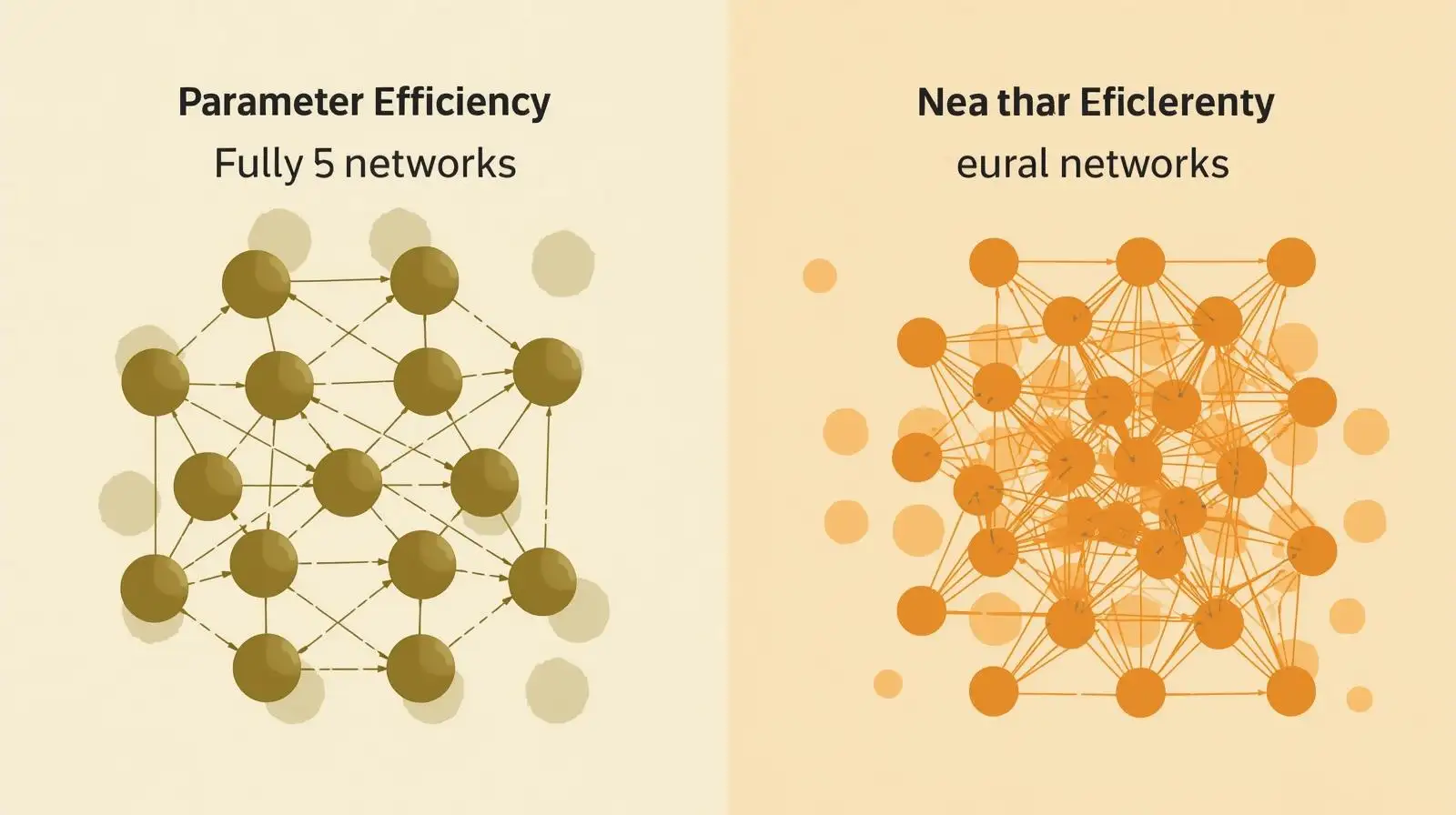
Parameter sharing dramatically reduces the number of learnable weights compared to fully connected alternatives. The same filter applies across the entire image, meaning a filter trained to detect vertical edges works regardless of where those edges appear. This sharing mechanism provides the translation invariance property crucial for robust visual recognition.
Pooling Layers: Downsampling and Spatial Invariance
Pooling layers reduce the spatial dimensions of feature maps, decreasing computational requirements while introducing additional translation invariance. Max pooling, the most common variant, divides feature maps into non-overlapping regions and outputs the maximum value within each region. This operation preserves the strongest feature activations while discarding precise location information.
Average pooling computes the mean value within each region rather than the maximum. While less commonly used than max pooling in intermediate layers, average pooling sometimes appears before final classification layers to aggregate spatial information across entire feature maps. Global average pooling reduces each feature map to a single value, eliminating spatial dimensions entirely.
The combination of convolution and pooling creates a hierarchical feature extraction pipeline. Each stage detects increasingly abstract patterns while reducing spatial resolution. By the final layers, the network has distilled raw pixel values into high-level semantic representations suitable for classification or other tasks.
CNN Architecture Design: Building Effective Visual Recognition Systems
Successful CNN architectures follow patterns established through extensive research and experimentation. Networks typically begin with convolutional layers using smaller filters that capture fine details, progressively increasing filter counts while reducing spatial dimensions through pooling. This pyramid structure enables learning hierarchical feature representations from simple to complex.
LeNet, developed in the 1990s for digit recognition, established the foundational CNN architecture. AlexNet's breakthrough 2012 ImageNet performance demonstrated deep CNNs' power for large-scale image classification. VGGNet showed that deeper networks with small filters outperform shallower networks with larger filters. ResNet introduced skip connections that enable training extremely deep networks exceeding 100 layers.
Modern architectures incorporate sophisticated design elements like batch normalisation, which stabilises training by normalising layer inputs. Inception modules apply multiple filter sizes in parallel, capturing features at different scales simultaneously. Attention mechanisms allow networks to focus on relevant image regions dynamically based on the classification task.
You rarely need to design CNN architectures from scratch. Pre-trained models like ResNet, VGG, and EfficientNet provide excellent starting points for most computer vision tasks.
Explore AI Tools →Transfer Learning: Leveraging Pre-trained CNN Models
Training CNNs from scratch requires massive datasets and substantial computational resources. Transfer learning offers a powerful alternative by starting with networks pre-trained on large datasets like ImageNet. The pre-trained network has already learned general visual features applicable across many image domains, reducing the data and computation needed to achieve good performance on new tasks.
Feature extraction uses pre-trained CNN layers as fixed feature extractors, training only a new classifier on top. This approach works well when target tasks resemble the original training domain and limited data is available. Fine-tuning takes transfer learning further by unfreezing some pre-trained layers and allowing weights to adapt to the new task, balancing general and task-specific feature learning.
Transfer learning democratises computer vision by making state-of-the-art performance accessible without massive datasets or computational budgets. A pre-trained model can achieve excellent results on specialised tasks with just hundreds of training images, compared to millions needed for training from scratch.
Real-World CNN Applications in Computer Vision
Image classification assigns images to predefined categories, powering applications from species identification to content moderation. Medical imaging applications detect diseases in X-rays, MRIs, and CT scans, often matching or exceeding radiologist accuracy for specific conditions. Agricultural systems classify plant diseases from smartphone photos, enabling early intervention that protects crop yields.
Object detection extends classification by localising objects within images using bounding boxes. Autonomous vehicles rely on real-time object detection to identify pedestrians, other vehicles, traffic signs, and obstacles. Retail applications track customer movements and product interactions. Security systems detect unauthorised entry or suspicious behaviour in surveillance footage.
Semantic segmentation classifies every pixel in an image, enabling precise understanding of scene composition. Medical applications segment organs and tumours for treatment planning. Autonomous driving systems segment roads, lanes, sidewalks, and buildings to understand navigable space. Satellite imagery analysis segments land use categories for urban planning and environmental monitoring.
Frequently Asked Questions
What is a convolutional neural network?
A CNN is a deep learning architecture specifically designed for processing visual data. It uses convolutional layers with learnable filters that detect features like edges, textures, and objects while preserving spatial relationships. The architecture exploits the structure of images to achieve efficient, accurate visual recognition.
Why are CNNs better than regular neural networks for images?
CNNs exploit spatial structure through local connectivity and parameter sharing. A regular network treating each pixel independently would need millions of parameters and couldn't recognise objects appearing in different positions. CNNs solve both problems—they're far more efficient and provide translation invariance for robust recognition.
What is transfer learning in computer vision?
Transfer learning uses pre-trained CNN models (trained on large datasets like ImageNet) as starting points for new tasks. The pre-learned features—edges, textures, shapes—transfer well to new domains, dramatically reducing the data and computation needed to achieve good performance on specialised applications.
What are pooling layers and why are they used?
Pooling layers reduce spatial dimensions of feature maps by taking maximum or average values within regions. This decreases computational requirements, provides additional translation invariance, and helps prevent overfitting while retaining the most important features for downstream processing.
What applications use convolutional neural networks?
CNNs power image classification, object detection, facial recognition, medical imaging diagnosis, autonomous vehicles, content moderation, augmented reality, satellite imagery analysis, and countless other applications. Essentially, any task requiring automated visual understanding likely uses CNN technology.
Explore Sequential Data Processing
CNNs excel at spatial data. For sequential data like text and time series, explore recurrent neural networks.
📚 Related Reading
💬 Questions or Thoughts?
Create a free account to join the conversation.